

Vietnamese iced coffee, called cà phê sữa đá, is strong, slow-dripped coffee mixed with sweetened condensed milk and poured over ice. It is dark, syrupy, and sweet, with a bitter edge that keeps it from tasting like dessert. You can make it at home with a small metal filter called a phin, or with a few close substitutes.
The short recipe: drip about 20 g of coarse-medium ground coffee through a phin into a glass holding 2 tablespoons of condensed milk, stir, then pour it over ice. The details below cover the coffee, the grind, the timing, and what to do when the drip goes wrong.
What Makes Vietnamese Iced Coffee Different
Coffee arrived in Vietnam under French rule in the 19th century, and the country now grows enormous amounts of it. Fresh milk was hard to keep in a hot climate, so shelf-stable condensed milk became the standard way to soften strong coffee. The habit stuck long after the reason faded.
Three things set the drink apart from the iced coffee most people make at home:
- The coffee is concentrated. A phin produces a small, intense cup, closer to espresso strength than to a mug of filter coffee.
- The sweetener is milk and sugar in one. Condensed milk gives body and sweetness together, so you do not need a separate syrup.
- The beans are often robusta. Vietnam is a leading robusta grower, and the bold, earthy, chocolatey character of that bean is what the drink is built around.
If you want background on the producing side, our look at the biggest coffee producing countries explains where Vietnam sits.
The Phin Filter and How It Brews

A phin is a small metal brewer that sits directly on top of a cup or glass. It has four parts: a chamber that holds the grounds, a perforated insert that you screw or press down on top of them, a lid, and a saucer-like base that catches drips when you set it aside. There is no paper filter and no pressure, only gravity and hot water.
Because the water passes through slowly, a phin takes several minutes to finish. That long contact time is why the coffee comes out so strong. It also means grind size and tamping matter more than they might seem.
The insert is the part you adjust. Pressed loosely, water runs through fast and the coffee tastes thin. Pressed hard, the drip slows to a crawl and the cup turns harsh.
Choosing Coffee for Vietnamese Iced Coffee
Traditional versions use robusta or a robusta-heavy blend, often roasted dark. Some traditional roasts are flavored during roasting, so check the bag if you want plain coffee. Robusta tastes heavier and more bitter than arabica, and that bitterness is exactly what the condensed milk is meant to balance.
If you are new to the difference, our guide to arabica and robusta covers flavor and caffeine in detail. For this drink, you have a few reasonable choices:
- A dark roast robusta or a blend with a high robusta share for the classic taste.
- A dark or medium-dark arabica if you find robusta too rough. The result is smoother and less traditional.
- Pre-ground Vietnamese-style coffee, which is already cut for a phin.
Grind to medium-coarse, a bit coarser than you would use for espresso and finer than French press. If you need a reference, the coffee grind size chart shows where that sits. Too fine a grind clogs the filter, while too coarse runs straight through.
How to Make Vietnamese Iced Coffee at Home
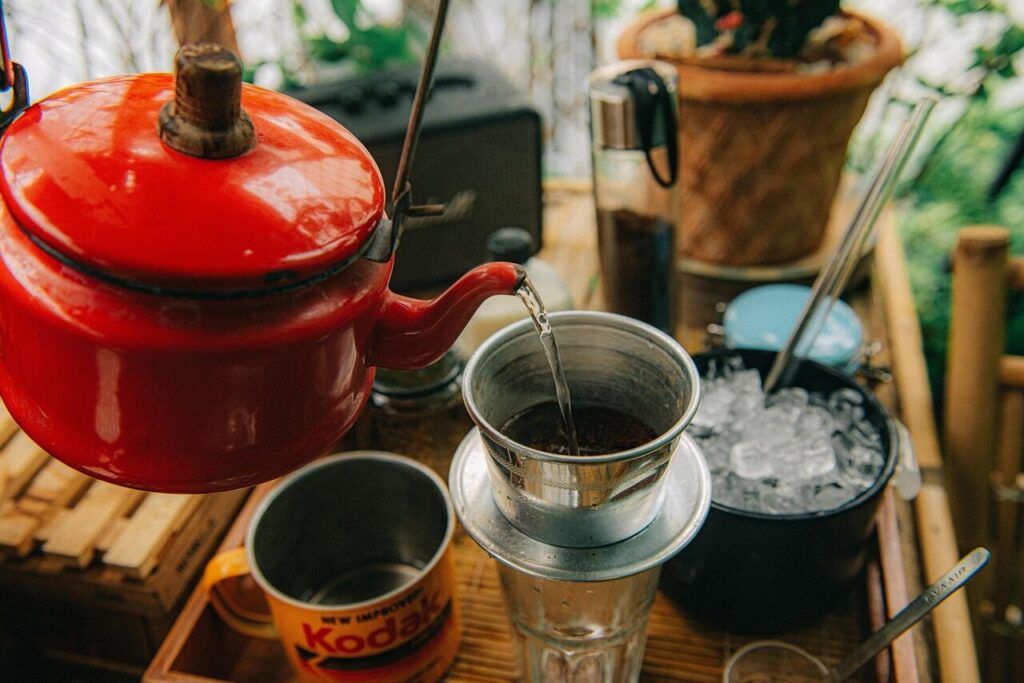
This makes one tall glass. The coffee-to-water ratio is deliberately high, so do not be alarmed by the small volume.
Ingredients and equipment
- 20 g / about 3 tbsp medium-coarse ground coffee
- 30 ml / 2 tbsp sweetened condensed milk, plus more to taste
- 100 ml / 3.4 fl oz water at 95°C / 203°F, just off the boil
- About 150 g / 1 cup ice cubes
- A phin with its insert and lid
- A heatproof glass, a spoon, and a second glass filled with ice
Steps
- Spoon the condensed milk into the bottom of the heatproof glass and set the phin on top.
- Add the ground coffee to the chamber and shake it gently so it lies flat.
- Place the insert on the grounds and press it down with light, even pressure. Do not pack it hard.
- Pour in about 30 ml / 2 tbsp of hot water to wet the grounds. Wait 20 to 30 seconds so the coffee swells and releases gas.
- Add the remaining hot water, about 70 ml / 2.4 fl oz, and put the lid on to hold the heat.
- Let it drip for about 4 to 5 minutes. A steady drip, not a stream, is what you want.
- Remove the phin and stir the coffee thoroughly so the milk dissolves into it.
- Fill the second glass with ice and pour the coffee over it. Stir once and taste.
Pour the hot coffee over the ice rather than adding ice to the drip glass. This chills the drink quickly, and the concentrated coffee holds up to the melt. For more on why some iced coffees turn weak, see our guide to making iced coffee that isn’t watery.

Fixing a Phin That Drips Wrong
Most problems come from the grind or the pressure on the insert. Use this as a quick diagnosis.
| Problem | Likely cause | Adjustment |
|---|---|---|
| Drips through in under 3 minutes | Grind too coarse or insert too loose | Grind a little finer or press slightly firmer |
| Stops dripping or takes over 7 minutes | Grind too fine or insert too tight | Coarsen the grind or loosen the insert |
| Tastes sour or weak | Water too cool or too fast a drip | Use water just off the boil and slow the drip |
| Tastes harsh and ashy | Over-extraction or very dark roast | Shorten the drip or try a medium-dark roast |
| Too sweet | Too much condensed milk | Reduce by a teaspoon at a time |
Change one thing per batch. If you adjust the grind and the pressure together, you will not know which fixed it.
Making It Without a Phin
A phin is cheap compared with most coffee gear, but you may not have one. The goal is a small, strong coffee, so any method that gives you that will work. These are the closest options:
- AeroPress. Use a concentrated recipe with a fine-medium grind. Our AeroPress guide covers the method, and you can use less water to reach phin strength.
- Moka pot. It makes a strong, bitter coffee that suits condensed milk well.
- Espresso. Two shots, about 60 ml / 2 fl oz, stirred into the condensed milk is a quick approximation.
The taste will not be identical, since the phin’s long, gentle drip gives a particular body. But the combination of dark coffee, condensed milk, and ice carries the character of the drink.
Variations You Will See in Vietnam
Cà phê sữa đá is the best-known version, but cafes serve many variations. The table compares the common ones.
| Drink | What it is | Character |
|---|---|---|
| Cà phê sữa đá | Phin coffee, condensed milk, ice | Strong and sweet |
| Cà phê đen đá | Phin coffee and ice, usually with sugar | Bitter and sharp |
| Bạc xỉu | Mostly milk with a little coffee, over ice | Mild, creamy, very sweet |
| Cà phê sữa nóng | The same drink served hot | Warm, thick, comforting |
| Cà phê trứng | Coffee topped with whipped egg yolk and sweetened milk | Custardy, dessert-like |
| Cà phê muối | Coffee topped with salted cream | Sweet with a salty finish |
| Cà phê cốt dừa | Coffee with coconut milk, often blended | Creamy and nutty |
If you find the standard drink too intense, bạc xỉu is the easiest step down: use the same condensed milk but pour in more milk and a smaller shot of coffee.
Sugar, Caffeine, and Substitutions
Condensed milk is sweetened with a lot of sugar, so the drink is closer to a treat than a plain coffee. If you drink several a day, it adds up. Start with 1 tablespoon and increase only if you need to.
Robusta generally contains more caffeine than arabica, and the phin brew is concentrated, so one glass can be stronger than it looks. People who are sensitive to caffeine, who are pregnant, or who have blood pressure concerns should ask a doctor how much is appropriate. Our pages on how much caffeine is in a cup and coffee during pregnancy give more context.
For a dairy-free version, look for plant-based condensed milk, often made from coconut or oat. Texture and sweetness vary, so taste before adding all of it. Dairy-free milks in general are compared in our article on the best milk for coffee.
Setting Up Your First Glass
Start with the exact recipe above and treat the first glass as a test. Time the drip, taste it, and note whether it needs a finer grind or less milk. By the third attempt, you will know your phin’s rhythm.
Serve it in a tall glass with a long spoon, and give it a final stir at the table, since condensed milk settles. Drink it while the ice is still sharp.
Frequently Asked Questions
Is Vietnamese iced coffee stronger than regular iced coffee?
Usually, yes. A phin brews a small, concentrated cup, and robusta beans generally carry more caffeine than arabica. The condensed milk softens the bitterness, so it can taste milder than it is.
Can I use arabica instead of robusta?
Yes. A dark or medium-dark arabica makes a smoother, slightly fruitier version. It is less traditional and lacks some of the earthy, chocolatey punch, but it still works well with condensed milk.
How long should a phin take to drip?
Roughly 4 to 5 minutes after the bloom is a good target. If it finishes much faster, the coffee will taste thin; if it takes far longer, it may turn harsh. Adjust grind and insert pressure.
Can I make a large batch ahead of time?
You can brew several phins and chill the coffee without milk for a day or so, then add condensed milk and ice when serving. Fresh drip tastes best, but this keeps the flavor reasonably well.
What is the difference between cà phê sữa đá and bạc xỉu?
Cà phê sữa đá is strong coffee sweetened with condensed milk. Bạc xỉu flips the proportions, using mostly milk and a small amount of coffee, so it tastes creamier, sweeter, and lighter.